

1. Introduction – An Enthusiasm to be Revamped
The enthusiasm surrounding AI in R&D is often based on a seductive promise: that of a significant acceleration in time-to-market.
The figures frequently put forward point to gains of 20% to 50% across the board, driven by visible use cases (generative design, simulation, document automation, etc.). However, this dominant narrative obscures a more nuanced reality.
As Robert Cooper (Ref. 34) points out, only 18% to 36% of AI projects actually achieve the expected benefits, depending on the type of gains targeted.
Even more worrying, 47% of projects never reach the production stage, trapped in a pilot phase with no follow-up, a phenomenon he describes as ‘pilot paralysis’.
This observation does not call into question the benefits of AI, but it does call into question the gap between promises and evidence. If we are to succeed, we need to understand why so many initiatives fail - and how to maximise their chances of success.
One factor in particular stands out: unrealistic expectations. Ranked as one of the most frequent and influential causes, this anticipation bias distorts the reading of results, discourages teams and compromises strategic alignment.
The problem is not just that AI does not deliver; it is also that it is expected to bring about transformations that no single technology can provide.
This article offers a critical re-reading of the promise of AI as a shortcut to the market.
The aim is not so much to curb enthusiasm as to equip R&D decision-makers to derive real, measurable and lasting benefits from their AI investments.
2. The Ambient Narrative
From vendor brochures to industry keynotes, a familiar claim is often repeated (Refs. 1 to 25):
“AI accelerates innovation by reducing time-to-market by 20 to 50%.”
The narrative typically unfolds as follows
- AI enables faster identification of optimal designs.
- AI anticipates failures earlier in the development cycle.
- AI automates repetitive tasks (e.g., documentation, data cleaning).
- AI improves portfolio and resource allocation decisions.
While these mechanisms are conceptually sound, the causal link between AI adoption and faster market launch is seldom scrutinized—and the figures cited are rarely supported by rigorous evidence.
3. Where the Evidence Falls Short
3.1. Lack of long-term studies
There is no broad empirical evidence showing that companies using AI in R&D consistently bring products to market faster. There is simply not enough track record available and not enough time elapsed to have long term retrospectives.
Most published case studies are short-term, focusing on proof-of-concept or pilot phases.
Much of the current understanding of AI's impact on time-to-market is based on anecdotal evidence or vendor-reported successes (Refs. 1 to 25).
Although legitimate, these accounts often lack the methodological rigor required for generalization, underscoring the need for more systematic, long-term studies.
The most widely cited examples (Refs. 1, 3, 5) are often
- Selective, only successes are shared
- Unpublished or vendor-controlled
- Confounded by parallel organizational changes
These examples highlight the prevalent use of anecdotal evidence in asserting AI's impact on reducing time-to-market in R&D. For a more comprehensive understanding, further empirical studies and longitudinal analyses are necessary.
3.2. Limited Empirical Evidence in Academic Literature
A review of academic publications (Refs. 26 to 29) reveals a scarcity of empirical studies that rigorously assess AI's long-term effects on R&D timelines.
While there is growing interest in AI's role in innovation, comprehensive studies measuring its sustained impact on time-to-market across various industries remain limited.
While these studies provide valuable insights into AI's role in enhancing R&D processes, they also underscore the current gap in long-term, comprehensive research assessing AI's impact on time-to-market. Further empirical studies are necessary to draw definitive conclusions across various industries.
3.3. Predominance of Forward-Looking Expectations
The Examples of McKinsey (Refs. 1, 5), repeated and sometimes unreliably meaning presenting expectations as facts or track record.
3.4. Challenges in Isolating AI's Impact
Isolating AI's specific contribution to reduced time-to-market is complex due to the frequent concurrent organizational changes.
For example, a case study (Ref. 10) by Cherry Bekaert describes a consumer goods company's transformation of its R&D processes using AI.
While the company reported faster innovation cycles, attributing this solely to AI is challenging given other simultaneous process improvements.
Moreover, companies investing in AI are also more likely to have more R&D funding or operate already with better processes.
Such advantages may, at least in part, explain the reported performance improvements, independent of AI's direct contribution. References 30 to 33 provide insights on factors that have significant impacts on R&D performance metrics. These factors include:
At country level
- Governmental R&D Funding
Increases in government R&D funding lead to sustained growth in long-term productivity, with effects becoming significant after about eight years and persisting for at least 15 years.
- International Talent Inflow and R&D Investment
The inflow of international talent increases firms’ R&D investment, with further confirmation from patent data.
At company level
- Talent Policy and Corporate Innovation
Implementation of talent policies significantly increases R&D personnel recruitment, leading to improvements in R&D investment, patent output, and R&D efficiency, particularly in high-tech enterprises.
- Process Maturity and Project Performance
Higher levels of process maturity in R&D projects attenuate the negative effects of project risks, leading to improved project performance.
While AI provides promising tools to enhance R&D efficiency, these foundational factors must also be considered, as they may contribute equally—or even more significantly—to observed performance gains.
In some cases, improvements in time-to-market may be primarily driven by such underlying strengths, with AI acting more as an enabler than the principal cause.
3.5. Variability in Metrics
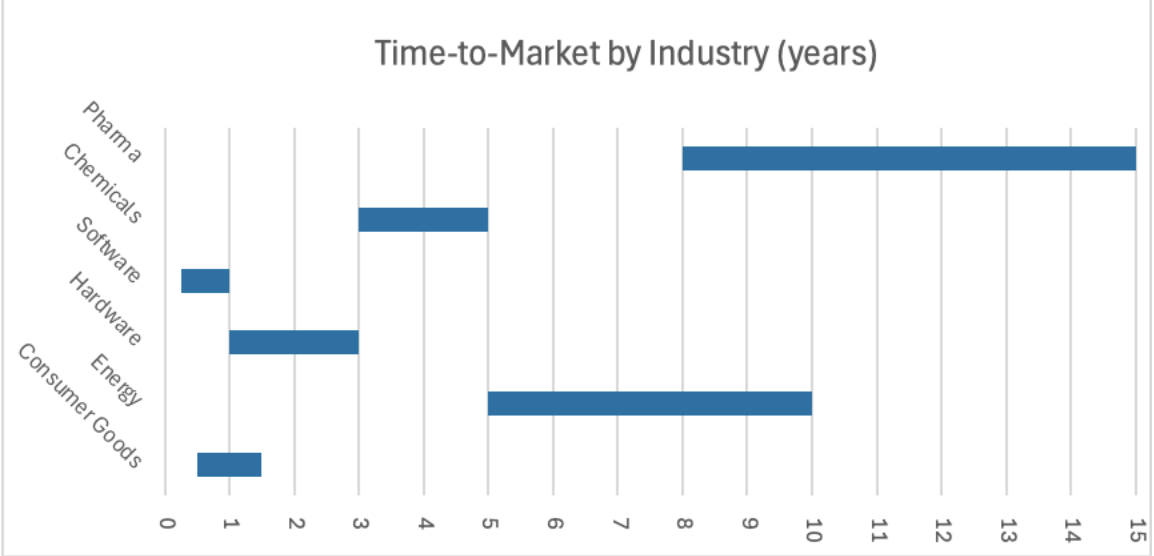
The definition of time-to-market varies widely across industries, shaped by differing regulatory environments, technological constraints, and customer expectations.
As a result, metrics are not standardized, making cross-sector comparisons, and attributions of improvement difficult. The table below illustrates how time-to-market is typically defined in different sectors.
|
Sector |
Typical Time-to-Market Definition |
|
Pharma |
Time from discovery to regulatory approval (often 8–15 yrs) |
|
Chemicals |
Time from lab validation to commercial scale-up (3–5 yrs), with a pilot phase in between |
|
Software |
Time from ideation to MVP/public release (3–12 months) |
|
Hardware |
Design to production-ready system (12–36 months) |
|
Energy |
From project origination to commissioning (5–10+ years) |
|
Consumer goods |
Concept to shelf-ready product (6–18 months) |
AI may accelerate specific steps in these processes but rarely transforms the entire timeline. Moreover, few organizations invest resources to track time-to-market with the rigor required to isolate AI’s specific contribution when other changes occur concurrently.
This lack of measurement consistency makes it difficult to substantiate broad claims about AI's overall impact on time-to-market.
3.6. Takeaway from the Literature: Misplaced Generalizations from Partial Gain
Taken together, the literature suggests that AI’s value in R&D is real but often mischaracterized.
Many authors, implicitly or explicitly, make the leap from task-level acceleration to system-wide transformation,assuming that gains in analysis, modeling, or design will necessarily compress the full time to market.
Yet the evidence does not support this generalization.
Time to market is shaped by complex, interdependent systems, many of which AI does not currently influence.
Without addressing scale-up bottlenecks, regulatory timelines, organizational inertia, or supply chain constraints, faster R&D tasks do not automatically translate to faster product launches.
Recognizing this gap is essential to forming realistic expectations about AI’s current and future role in innovation timelines.
4. Does AI Really Shorten Time-to-Market in R&D?
As shown in the previous section, despite the enthusiasm, many claims about AI shortening time-to-market rely on a flawed assumption: that accelerating a few tasks automatically accelerates the entire process.
AI does prove effective in accelerating specific R&D tasks.
However, time-to-market depends on broader systems - manufacturing, regulatory approvals, supply chains, and organizational dynamics—which AI has yet to meaningfully transform.
4.1. Limits: The Bottlenecks AI Doesn’t Remove (Yet)
Some of the most persistent delays in R&D still lie outside AI’s reach:
- Regulatory approvals
- Supply chain and equipment lead times
- Manufacturing scale-up and validation
- Integration with legacy systems
- Change resistance within organizations
- Scarcity of domain-specific talent.
These are structural constraints. While AI may support adjacent tasks, it does not currently transform these systems end-to-end. As a result, speeding up a few steps rarely shifts the overall delivery date unless the entire system is optimized.
4.2 Gains: Where AI Actually Helps
Where AI does have a measurable impact is in reducing internal inefficiencies,accelerating early-stage work, and supporting faster decision-making.
Examples include:
- Data triage: extracting faster insights from historical datasets
- Hypothesis ranking: narrowing down what to test
- Virtual prototyping: simulating product concepts
- Automated documentation: speeding up admin-heavy tasks
Beyond these core gains, a growing range of applications now includes
- Generative design and simulation
- Faster molecule screening and trial design in pharma
- Natural language search of research databases, code generation and automated lab analysis
- Forecasting, risk assessment, and budget modeling
- Lifecycle and manufacturing process simulations
- Synthetic data creation and customer feedback analysis
5. Turning AI Potential into Performance in R&D
5.1. Don’t Expect Blanket Time-to-Market Gains
- Time-to-market is not a uniform, monolithic metric. It varies widely by sector and includes operations that AI has no influence on.
- Avoid setting arbitrary goals like “20% faster time-to-market.”
5.2. Target Specific Steps, Measure Local Impact
- Focus instead on specific steps or bottlenecks where AI may accelerate learning, reduce rework, or improve decision quality.
5.3. To Reap the Benefits, R&D Still Needs to Be Actively Managed
- AI doesn’t replace the need for R&D strategy, governance, and team orchestration.
- Success with AI depends on
- Clear integration points in the R&D workflow
- Alignment with the strategic priorities of the project portfolio, to support key objectives;
- Development of a culture of continuous experimentation and accountability, where teams are encouraged to test new approaches and report on their results.
- AI is a multiplier, not a replacement. It magnifies both good systems and dysfunctional ones.
5.4. Change Management and IT support as Operational Enablers
Transitioning to AI in R&D isn’t a plug-and-play upgrade. It demands structural and cultural readiness. It is a transformation, not a quick fix.
- Ensure IT integration: Plan early for how AI tools will access relevant data, plug into existing systems, and support decision workflows.
- Lead with change management: Prepare teams to adapt by clarifying new roles, building trust in AI outputs, and embedding training into project cycles.
5.5. AI in R&D: Promise vs. Practice
To help navigate claims about AI’s impact on time-to-market, the table below highlights common narratives, observed gaps, and key questions to ask.
|
Common Claims |
|
|
Observed Gaps |
|
|
What to Clarify for a Successful Transition |
|
6. Conclusion - What Does a More Accurate Narrative Might Say?
The promise of faster time-to-market through AI is widely repeated—but the proof remains limited, partial, and highly context-dependent.
This review highlights three key takeaways:
- Narratives often exaggerate impact without disclosing scope, supporting data, or implementation details.
- Time-to-market is not a universal metric and AI rarely improves it in isolation.
- Performance gains depend on orchestration,not just tool adoption—integrating AI into workflows, governance, and decision systems is essential.
The causes of failure in AI projects are often avoidable - ‘mostly dumb reasons’, in Dr Cooper's own words. Among the seven main reasons are some classic but all too neglected factors: poor data quality, lack of understanding of user needs, and lack of change management. As we observe in practice, these factors explain why some experts estimate the failure rate to be as high as 80%, almost twice as high as traditional IT projects a decade ago.
But the problem runs deeper than isolated missteps. Real performance gains require orchestration. Improving one step in the chain is not enough if inefficiencies resurface elsewhere. Just like a set of equipment doesn't make a working electric grid, a stack of AI tools doesn’t create operational excellence on its own.
Such a level of failure should be a wake-up call. Based on the sources reviewed in this article, for AI to deliver on its promise, adoption isn’t enough. It must be orchestrated. Process, governance, and strategic alignment remain the real enablers of impact.
So a more accurate narrative would read:
AI accelerates innovation by reducing time-to-market—in organizations that move in sync with the algorithms.
7. References
7.1. Examples of publications discussion time-to-market in AI-assisted R&D
1. McKinsey - "Using AI to supercharge R&D: Takeaways from the R&D Leaders Forum " (Using AI to boost R&D: lessons from the R&D Leaders Forum)
Highlights an expectation by 40 R&D leaders of a 20 to 40% reduction in time-to-market through AI applications like generative design and simulation.
2. BCG - AI-Powered R&D
https://media-publications.bcg.com/BCG-Executive-Perspectives-AI-Powered-RandD-EP1-14Feb2025.pdf
Shares the expectation that AI can reduce time-to-market by 10–20% and lower R&D costs by up to 20%, emphasizing the need for operating model transformation. The document shares several other expectations without proof points.
3. Roland Berger - "AI in R&D will lead to more innovative products and efficient processes".
Reports that companies using AI in R&D will experience accelerated innovation and up to 25% lower costs. The article doesn’t share data supports this claim
4. INFORMS - "How AI is Accelerating Speed to Market"
https://pubsonline.informs.org/do/10.1287/LYTX.2024.04.08/full/
Explores how advancements in AI and generative AI are accelerating the speed of bringing products to market. No quantitative claims made in the article.
5. McKinsey - "How generative AI could accelerate software product time to market".
Offers early lessons on how generative AI can improve product managers' productivity and quality, potentially accelerating time-to-market. The article claims that “Gen AI accelerated product time to market by 5 %” based on “ empirical research on PMs in Europe and the Americas” with no further details.
6. Quadrillion Partners - "AI-Driven Product Innovation: Accelerating Time to Market".
While the article emphasizes the potential of AI to significantly shorten time to market, it does not provide specific quantitative metrics or empirical data to substantiate these claims.
7. Accenture - Reinventing R&D in the Age of AI
https://www.accenture.com/us-en/insights/life-sciences/the-rd-opportunity
Highlights that AI-driven R&D significantly reduces drug discovery times and costs associated with bringing new therapies to market in the Biopharma Industry. It mentions specific tasks as being accelerated: “AI accelerates target identification, enhancing drug discovery efficiency.”, “With an AI-led discovery strategy, companies can reduce discovery cycle times by two-thirds.”. The basis for time-to-market reduction claims remains inaccessible to scrutiny, for instance: « Our analysis shows that if intelligent technologies are used at scale and workflows are reinvented appropriately to reduce the cost of failure and shorten discovery and development timelines, companies can bring a new medicine to market four years faster… »
8. Digital product development 2025 - PWC
https://www.pwc.de/de/digitale-transformation/pwc-studie-digital-product-development-2025.pdf
Companies expect digital product development, including AI, to reduce time-to-market by 17%, and among them, the Digital Champions project up to a 28% reduction. However, the report provides no detail on how these expectations are formed.
9. AI in R&D: transforming the innovation landscape - GreyB
https://www.greyb.com/blog/ai-in-research-and-development/
Highlights that, traditionally, bringing a drug from concept to market takes about 12 years. Gives one example of a company leveraging AI to accelerate this process, aiming to develop weight loss and diabetes drugs that could enter clinical trials in just 1.5 years.
10. Case-study - Reinventing Innovation: Using AI to take R&D from Art to Science - Cherry Bekaert
Describes a consumer goods company's transformation of its R&D processes using AI, alongside other simultaneous process improvements that also contributed to the observed gains.
11. How real-world businesses are transforming with AI — with 261 new stories
The article highlights various corporate applications of AI, including some in R&D. It claims that ”Generative AI is revolutionizing innovation by speeding up creative processes and product development. It’s helping companies come up with new ideas, design prototypes and iterate quickly, cutting down the time it takes to get to market. In the automotive industry, it’s designing more efficient vehicles, while in pharmaceuticals, it’s crafting new drug molecules, slashing years off R&D times.”.
However, the only concrete R&D-related example provided is from Bayer: “Bayer built an agent using Copilot that lets their Crop Science researchers and scientists search the tool using natural language. What previously could take days to find the information, now saves R&D teams 3 to 6 hours per researcher per week.”
12. Mc Kinsey - Generative AI in the pharmaceutical industry: Moving from hype to reality
McKinsey links generative AI to a strategic response to asset lifecycle compression in pharma : « Furthermore, by increasing the speed at which therapies can be developed, approved, and marketed, gen AI can help pharmaceutical companies address the issue of “asset lifecycle compression”—the decreasing amount of time companies have to capture a new drug’s value. Over the past two decades, that time frame has fallen by almost 18 months: to 9.8 years, from 11.7, McKinsey research has found. » While the context is compelling, the supporting evidence for AI’s direct contribution to reducing development and approval times remains largely anecdotal. No quantified gains or longitudinal studies are cited, making it difficult to assess the real extent of impact beyond illustrative examples.
13. Mc Kinsey - Early adoption of generative AI in commercial life sciences
14. Artificial intelligence in drug development: reshaping the therapeutic landscape - Therapeutic Advances in Drug Safety 2025, Vol. 16: 1–24
https://journals.sagepub.com/doi/epub/10.1177/20420986251321704
The article explicitly states that AI reduces drug development timelines, and provides some quantification examples “Time to approval accelerated by 1–2 years” (Section: Higher possibility of success), “...a 12-plus month acceleration in the time it takes to conduct a trial” — (Ibid.).It provides an example lacking background: Heal-X (HLX-0201): Moved a candidate to Phase II in 18 months, without comparing this to prior duration.
It provides expectations for time-to-market reduction drawn from frequently cited vendor sources:
- Predicted benefit: “up to 50% cost reduction, 12+ months acceleration, and 20% NPV increase.” (Section: Higher possibility of success). This is backed by the McKinsey reference “Generative AI in the pharmaceutical industry: Moving from hype to reality” that provides no solid evidence to the claim.
- Estimated savings: Drug development cost reduced by billions, timeline by 1–2 years. Also backed by the McKinsey reference “Early adoption of generative AI in commercial life sciences” that provides no factual evidence to the claim.
15. AI and the R&D revolution - Financial Times, November 27, 2024
https://www-ft-com.ezp-prod1.hul.harvard.edu/content/648046c1-7fcd-43fb-819b-841f104396d9
Explores how artificial intelligence (AI) is transforming research and development (R&D) across various industries. It delves into the ways AI technologies are being integrated into R&D processes to enhance efficiency, reduce costs, and accelerate innovation.
The only supporting material for claims of AI impact is the McKinsey study " Using AI to supercharge R&D: Takeaways from the R&D Leaders Forum ".
16. How AI-Augmented R&D Is Changing the Landscape of Research Industries – Ip.com
https://ip.com/blog/how-ai-augmented-rd-is-changing-the-landscape-of-research-industries/
This article relates other sources’ expectations: « The integration of Artificial Intelligence (AI) into research and development (R&D) processes is having a transformative impact on productivity.
Numerous studies and industry estimates suggest that AI can:
- improve search workflow productivity by 30 to 50 %
- product performance up to 60 %
- time-to-market up to 40 %".
“By dramatically accelerating data analysis and thanks to Enhanced Predictive Modeling and Simulation, AI allows researchers to move from the data collection phase to actionable insights faster, leading to more efficient use of time and resources. This could contribute to the higher end of the 30–50% productivity boost.”
17. AI in Product Development: Netflix, BMW, and PepsiCo – Virtasant
https://www.virtasant.com/ai-today/ai-in-product-development-netflix-bmw
The article emphasizes that faster time-to-market results from an integrated strategy—not tools alone. However, the claim that “companies that use AI in their product development processes can reduce the time to market by 20–40%” is supported only by a single McKinsey publication “How generative AI could accelerate software product time to market”, with no additional data or case-specific validation.
18. How AI agents are reshaping R&D
Gives operational examples of how AI helps reduce workloads to humans, bottlenecks and helps reduce timelines. However, it offers no quantification.
19. AI in Product Development: How Businesses Are Cutting Time-to Market by 50%
https://blog.hoyack.com/ai-in-product-development-how-businesses-are-cutting-time-to-market-by-50/
Relies on the now-familiar narratives about AI-induced acceleration - largely descriptive and devoid of original data. Claims are supported by the same widely cited consultancy studies as other sources, without offering additional validation or differentiated insights.
20. AI Enhances R&D Productivity by Reducing Physical Tests
https://ip.com/blog/how-ai-augmented-rd-is-changing-the-landscape-of-research-industries/
AI is said to reduce the need for time-consuming physical tests, thereby enhancing R&D team productivity and speeding up product launches.
21. AI Accelerates Drug Discovery but Faces Clinical Challenges
While AI speeds up drug discovery, the benefits may be delayed if clinical development doesn't keep pace.
22. AI Shortens Product Development Cycles in Manufacturing
https://ambilio.com/how-generative-ai-can-reduce-time-to-market-in-manufacturing/
Generative AI is reported to reduce time-to-market in manufacturing by automating design and prototyping processes.
23. AI Transforms R&D in Consumer Packaged Goods
A CPG company leveraged AI-led data processing to improve R&D efficiency and reduce go-to-market time.
24. AI Drives Faster Product Development in Tech Startups
Tech startups report that AI enables quicker prototyping and product iterations, leading to reduced time-to-market.
25. How AI Is Accelerating Innovation In Research And Development
Articles like this one in Forbes continue to propagate broad claims such as ‘AI is transforming R&D and reducing time-to-market’ without providing grounded empirical evidence.
It exemplifies the reliance on optimistic executive perception rather than independent performance metrics. It aligns with the broader trend of enthusiasm outpacing validation.”
|
Claim made |
Supporting evidence level |
|
Generative AI speeds up ideation and reduces time to market in automotive and pharma |
Anecdotal (one example: Bayer Copilot) |
|
AI can reduce time to market by 20–40% |
Not reported (repeats McKinsey projection) |
|
AI enables up to 50% time to market reduction |
Not reported (relies on consulting studies) |
|
GenAI can bring new drugs to market 4 years faster |
Benchmarked but proprietary (McKinsey) |
|
Digital product development reduces time to market by 17% (28% for champions) |
Survey-based (expectations, no methodology) |
|
AI reduced search time at Bayer by 3–6 hours/week per researcher |
Anecdotal (operational efficiency, not time to market) |
|
International talent inflows increase R&D investment and innovation |
Empirical (firm-level data, patents) |
|
Government R&D funding increases productivity and innovation with lag |
Empirical (long-term macroeconomic analysis) |
7.2. Academic studies
We have found only very few academic studies that examine AI's impact on R&D timelines. While these studies provide valuable insights, it's important to note that comprehensive, long-term empirical research on this topic remains limited.
The existing literature often focuses on specific sectors or short-term outcomes, highlighting the need for more extensive longitudinal studies.
26. Economic impacts of AI-augmented R&D – Research Policy (2024)
https://www.sciencedirect.com/science/article/pii/S0048733324000866
This is a macro-growth modeling paper using micro-level AI benchmarks to make a plausible case that AI-augmented R&D—due to its capital-intensity—could structurally raise the economy’s innovation speed, but important caveats remain, including the domain-specific nature of the benchmarks, the absence of long-term empirical data across sectors, and the exclusion of non-technical factors such as governance and organizational adoption.
27. The impact of AI adoption on R&D productivity – Technovation (2025)
https://www.sciencedirect.com/science/article/abs/pii/S1049007825000144
Focusing on the pharmaceutical sector, this paper examines the relationship between AI adoption and new drug R&D productivity. It provides early empirical insights but notes that comprehensive, long-term studies are necessary to fully understand AI's impact on R&D timelines and productivity. It discusses how AI can revert the long-term R&D decrease in productivity.
28. Time to Market Reduction for Hydrogen Fuel Cell Stacks using Generative Adversarial Networks – arXiv (2022)
https://www.sciencedirect.com/science/article/abs/pii/S0378775323006626 https://arxiv.org/pdf/2212.11733
This study presents a novel approach using AI to reduce the development time of hydrogen fuel cell stacks. While it shows promising results in shortening specific R&D processes, the paper highlights the need for broader studies to assess long-term impacts on overall time-to-market.
29. AI and the future of pharmaceutical research – arXiv (2021)
https://arxiv.org/pdf/2107.03896
This paper discusses the transformative potential of AI in pharmaceutical research, suggesting that AI can significantly reduce drug discovery times. However, it also points out that more longitudinal studies are needed to validate these claims across the entire R&D lifecycle.
7.3. Reports on Factors Affecting Time to Market
7.3.1. On R&D Funding and Long-Term Productivity
30. Government-funded R&D produces long-term productivity gains, Federal Reserve Bank of Dallas (2024)
https://www.dallasfed.org/research/economics/2024/0213
The article shows that nondefense government R&D funding leads to long-term gains in innovation, productivity, and scientific capacity—though with a delayed effect. These investments increase inputs like skilled researchers and patents, which can indirectly accelerate product development over time. While not addressing time-to-market directly, the findings suggest that public R&D creates conditions that can shorten the time to market in the long run.
7.3.2. On Talent Policy and Corporate Innovation
31. Talent Policy, R&D Personnel Recruitment and Corporate Innovation, Frontiers of Business Research in China (2023)
https://journal.hep.com.cn/fbr/EN/10.3868/s070-008-023-0008-8
“After the introduction of talent policy, there have been significant improvements in enterprises' R&D investment, patent output and R&D efficiency.” These findings indicate that by bolstering R&D capabilities, talent policies can enhance the efficiency and speed of the innovation process, which is directly related to reducing time to market.
7.3.3. On Process Maturity and Project Performance
32. Risk, Process Maturity, and Project Performance: An Empirical Analysis of U.S. Federal Technology Projects, Production and Operations Management (2015)
https://onlinelibrary.wiley.com/doi/abs/10.1111/poms.12513
This study quantifies how internal risks—such as complexity, execution issues, and contracting challenges—affect a project’s ability to stay on schedule and on budget, using a composite metric. Based on a large dataset of 519 quarterly observations, it shows that process maturity significantly mitigates these risks, improving schedule performance. While not focused on time-to-market per se, the findings directly inform how risk management and execution processes influence timely delivery of R&D outcomes.
7.3.4. On International Talent Inflow and R&D Investment
33. International talent inflow and R&D investment: Firm-level evidence from China, Economic Modelling (2018)
https://www.rieb.kobe-u.ac.jp/academic/ra/dp/English/DP2019-17.pdf
While not explicitly focused on time-to-market, this study shows that international talent inflows boost both R&D investment and innovation outputs—key enablers of accelerated product development. By strengthening firms’ innovation capacity, such inflows can indirectly contribute to shorter time-to-market. The findings, based on patent data and firm-level R&D metrics, highlight how talent-driven capabilities play a strategic role in speeding up the innovation cycle.
7.3.5. Additional Insight from Practice
34. Dr Robert Gravlin Cooper, Plenary Session and Closing Remarks of the AI for Innovation web conference, organized par LIV.INNO, May 7th, 2025
About the author
Jérôme Gosset is a fractional executive director of R&D operations, specializing in the development and turnaround of R&D performance in innovative companies.
He excels at turning around R&D organisations where teams are struggling to reach their full potential and developing new activities, teams and processes around innovative technologies. Jérôme is also able to lead complex strategic initiatives involving multiple partners.
What sets Jérôme apart is his ability to navigate in highly complex environments. His diverse background in science and technology, combined with his experience in managing teams and portfolios of R&D projects, enables him to make a significant contribution to his clients' growth.
He is known for his inspiring vision and meticulous execution. His leadership has led to several successful transformations, generating results worth tens of millions of dollars.
Jérôme's unique ability to tackle business and technology challenges has earned him several board appointments.