

The Test of Power Without Proper Control
Book II of Ovid's Metamorphoses holds a timeless lesson in R&D governance through the myth of Phaethon. Having obtained temporary custody of the Chariot of the Sun, the young driver Phaethon seizes the reins of the most powerful vehicle in the cosmos. The pulling force is at its maximum, and the speed instantly escapes all measure.
Yet, from the very first moments of the race, a stark reality becomes clear: the driver possesses neither the alignment strength nor the methodological benchmarks to govern the machine's trajectory. The divine horses sense this lack of a guiding hand and veer off the established path. The chariot runs wild, setting cities ablaze, evaporating rivers, and threatening the cosmos with a chaotic collapse.
Faced with imminent destruction, Jupiter, the figure of sovereign authority, intervenes inflexibly to halt the vehicle's drift. He then compels Apollo to reclaim his role as pilot, subjecting the horses to strict laws of trajectory. It is only through the restoration of a clear and protective framework that the cycle of day and night regains its immutable order.
Corporate R&D departments are set to experience their own "Phaethon moment" in the coming years. The market for artificial intelligence tools in R&D expands every day, beginning to automate literature reviews, hypothesis generation, design, coding, computation, as well as the writing of papers and engineering reports.
This acceleration of operational execution profoundly alters the balance of information flows. If the pace of generating technical data outstrips the company's capacity for arbitrage, the decision-making process faces a major structural bottleneck. Consequently, this increase in performance—in terms of the capacity to explore multiple options and the speed of technical development—demands a renewed governance model.
The Imbalance in the Offer of AI Products for R&D
Pyonnier conducted a daily monitoring of announcements for new AI products and features in R&D, systematically carried out via Google Alerts over the first six months of 2026.
The empirical data collected demonstrates that the current supply of AI products for R&D is characterized by a stark imbalance between R&D execution and R&D steering:
- 92 % of existing solutions (66 out of a panel of 72 tools) focus exclusively on the operational level and specialized technical expertise.
- Only 8 % of the existing solutions (6 out of 72 tools) address governance, portfolio management, and managerial decision support.
Furthermore, for specialized solutions, a detailed analysis of the innovation funnel (which we have mapped across seven key stages: idea generation, conceptualization, business case development, technical development, testing phases, commercial launch, and operational support) highlights a massive concentration:
- at the Development stage, with 43 recorded tools,
- and at the Testing Phases stage, with 10 dedicated tools (excluding tools embedded in hardware and pure automation utilities).
This plethora of new tools, whose power is completely unprecedented compared to previously available software, has the potential to propel industrial R&D centers into ultra-fast innovation production cycles. Thanks to specialized algorithms, engineers and researchers will soon possess the ability to simulate thousands of designs, formulate complex mixtures, or generate engineering code at unprecedented frequencies.
The acceleration of technical execution is becoming a tangible reality, but the human capacity to absorb and arbitrate these results remains, by nature, unchanged.
Thus, accelerating technical work will shift the operational constraint: it will push the burden downstream and create a new bottleneck at the strategic arbitrage level, where the pace of absorption remains flat due to a lack of AI tools dedicated to governance.
As executive committees face a growing volume of technical variants and faster-produced deliverables, the organizational structure risks becoming congested and slowing down projects... For the gained speed to effectively translate into a faster time-to-market, this abundance of information must be channeled through a tailored governance framework. In other words, a governance model that fosters a measured approach to decision-making, supported by filters capable of highlighting information critical to decision-making.
Classification Grid for R&D AI Tools
To seamlessly organize the integration of AI into R&D and preserve management's capacity for arbitrage, establishing a clear nomenclature stands as a fundamental benchmark.
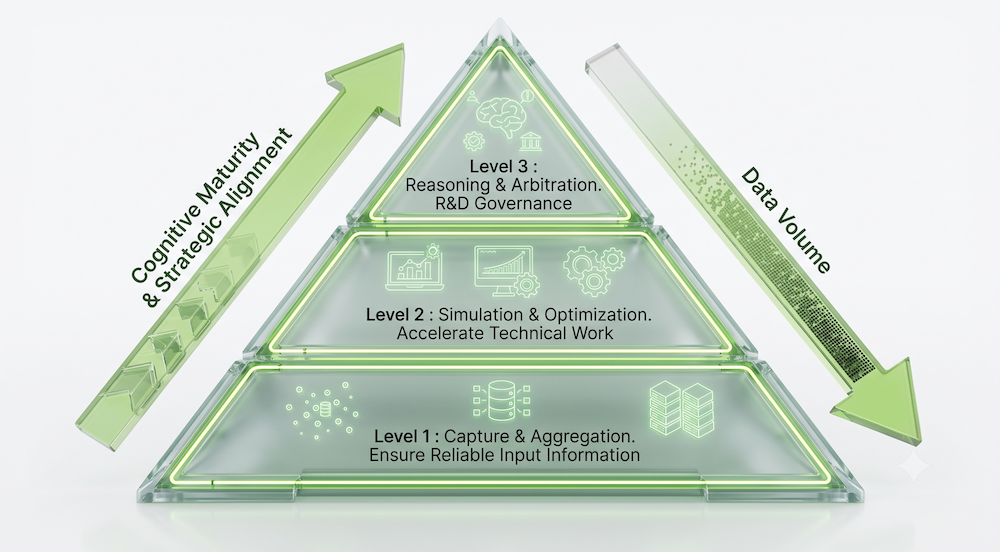
This categorization allows for the segmentation of the AI ecosystem into three levels of cognitive maturity, clearly defining the scope of action and the role of each tool deployed within the enterprise.
| Maturity level | Nature of the contribution | Examples of operational roles | Impact on governance |
| Level 1 Capture & Aggregation | Factual and Passive | Global state-of-the-art capture, regulatory monitoring, and patent mapping. | Fiabilization of inputs. |
| Level 2 Simulation and Optimization | Analytical and Specialized | Acceleration of calculation cycles, property predictions, formulations, and design | Drastic increase in the volume of options explored and the speed of results production |
| Level 3 Reasoning & Arbitrage | Systemic and Decision-Driven | Cross-criteria orchestration, risk modeling, business implications analysis | Drastic increase in strategic analysis and decision-making capacity |
Level 1 – Capture and Aggregation Systems
Level 1 technologies form the informational infrastructure foundation of modern R&D. They encompass specialized semantic search engines, platforms for the automated processing of scientific publications, and technological or regulatory monitoring tools.
The primary value of these solutions lies in the fiabilization of documentary inputs. By instantaneously cross-referencing global patent databases and the technical state of the art, these algorithms reduce by several orders of magnitude the time required to establish Freedom to Operate analyses, for instance.
Nevertheless, the authority of these systems remains strictly passive and informative. They act as excellent compasses mapping the macroeconomic and legal environment outside the company, but they do not integrate any parameters related to internal capabilities. They inform the structure without providing the decision metrics required to arbitrate capital allocation or project prioritization within the portfolio.
Level 2 – Simulation and Optimization Systems
Level 2 represents the core of the technological concentration identified by our monitoring, encompassing surrogate models, physics-informed artificial intelligence, and augmented laboratory notebooks. It is at this stage that the true leap in speed occurs within the execution of industrial R&D.
This AI-driven acceleration, however, focuses exclusively on the technical dimension, operating by nature within a precise domain of specialization and expertise. Algorithms propose optimized options, but only by tying themselves to a targeted aspect of development (for example, a chemical formulation, without integrating at this milestone the industrial challenges of chemical or process engineering).
Nevertheless, the scope of these systems remains strictly analytical and specialized. They act as excellent engines of performance within a circumscribed technical domain, but they do not integrate the transversal dimensions inherent to corporate reality. They optimize sector-specific execution without providing the synthesis indicators required to arbitrate the overall viability of the options within the project portfolio.
Level 3 - Reasoning and Arbitrage Systems
The true frontier of innovation governance lies in Level 3, a technological category that still occupies a limited share of the market. This level moves beyond simple documentary productivity or technical specialization to focus on systemic integration and strategic decision support.
These systems are built on explainable (Explainable AI - XAI) architectures and autonomous multi-agent protocols. By allowing these entities to debate using the company's R&D management information, these platforms enable an executive team to challenge its own assumptions with the rigor of an independent audit committee, and within a cycle time compatible with that of Level 2.
This Level 3 approach offers a direct solution to the major risk of management methods becoming obsolete in the face of accelerating R&D. Integrating Level 3 AI into R&D steering processes represents a substantial upgrade to corporate R&D governance, providing the indispensable structure for a drastic increase in strategic analysis and decision-making capacity. This approach fosters a streamlined decision-making process that reduces the flow of technical information to a level that is reasonable to process and can be directly utilized by decision-makers.
At the strategic level, Level 3 makes it possible to reconcile the requirements of sound corporate governance with the mandates of speed, thereby preventing developed initiatives from joining the statistic of 90% of innovations that never generate revenue.
Conclusion – When the Sun Chariot Regains Its Course
The widespread adoption of operational artificial intelligence represents a historic opportunity to increase the efficiency of companies' technological developments. However, integrating this power demands the concomitant establishment of an adapted governance infrastructure, capable of matching this new way of "doing R&D."
For executives, the immediate challenge lies in analyzing the AI solutions deployed or to be deployed internally in light of this classification grid. Identifying the exact nature of each tool's contribution makes it possible to synchronize the technical execution speed of engineers with the strategic steering capacity of management. It is through this prerequisite of rigorous alignment between team performance and the company's economic realities that innovation sustainably transforms into industrial value and a lasting competitive advantage.
Just as in the conclusion described by Ovid, where the course of the Sun Chariot is secured to preserve the balance of the world, industrial R&D must adopt a modern approach to decision-making. Far from stifling creative momentum, rigorous screening protects the company’s resources by focusing solely on projects with demonstrable technical and commercial viability.