


Designing a standard isn't just about writing a technical document.
It's about creating a collective object, with all the human, political, industrial and technical constraints that implies.
When the CSA and BNQ asked me to chair the committee tasked with developing a new standard on the carbon intensity of hydrogen, they entrusted me with a role that went well beyond coordination: it was a matter of organising a joint effort in a territory that was still relatively uncharted, and delivering a useful product - on time.
What this project has taught me about fractional R&D management
And why this article is more than a simple explanation of a standard
For me, this project was an excellent exercise in the role of fractional R&D operations manager. I found in it all the typical ingredients of my mandates:
- Leading a team of highly-experienced people on a complex subject, making sure that everyone remained mobilised - despite the voluntary nature of their involvement.
- Embracing the initial ambiguity of a loosely framed mandate and rapidly clarifying its purpose, priorities, and deliverables.
- Quickly learning what was needed to be able to arbitrate, guide and make decisions when necessary - without claiming to be the most expert around the table.
- Creating alignment between a still-evolving vision (from the CSA-BNQ duo) and a clear, robust, and applicable end result.
- Managing blind spots and tensions between political ambitions, industrial requirements and scientific rigour.
- Supporting the appropriation of the result - in this case the standard - by making it easier to understand and by helping the players to appropriate it, as I often do for R&D deliverables or innovation roadmaps.
So, this article is not just an instruction manual. It's also a natural extension of my role: to support the adoption of the result, by explaining its structuring choices, its implications and its uses. A fractional manager doesn't stop at delivery. They ensure that what has been designed is useful and put to good use!
In this sense, this experience of standardisation is a good illustration of the value that an R&D executive can bring, even in environments that are neither laboratories nor factories: clarity, pace, alignment and impact.
A Turning Point for Clean Hydrogen Thanks to the CSA/BNQ Standard

When the Rainbow Must Fade
In the CleanTech world, where hydrogen plays a central role in the energy transition, a colorful spectrum has long framed the conversation: green, blue, grey, and even pink hydrogen, each defined by its production methods and energy sources.
But while this color classification seems simple, it has always obscured a deeper complexity — the real environmental impact of different hydrogen production pathways.
The recent publication of the CSA/ANSI R124/BNQ 1789-200 standard, "Harmonized Methodology for Communicating Hydrogen Production Pathway and Carbon Intensity Data", marks a major shift. More than a technical adjustment, it’s a revolution in how we assess the environmental value of hydrogen — replacing colors with precise figures and robust data.
This standard was developed in response to growing concerns about clarity and transparency in how hydrogen data is shared, especially in the context of decarbonization efforts and sustainable development goals. The debate that led to its emergence highlighted the need for a more nuanced, science-based approach.
A Strategic Initiative Led by Trusted Organizations
This standard was born from the efforts of two key Canadian institutions: CSA (Canadian Standards Association) and BNQ (Bureau de normalisation du Québec), both well-recognized bodies in North America.
CSA, with over 100 years of history, is an internationally active standards organization covering a broad range of sectors, including energy, safety, and the environment.
BNQ, while primarily focused on Quebec’s specific needs, is renowned for its work on sustainability-oriented standards that respond to market realities.
Together, they launched a joint initiative to clarify and harmonize how clean hydrogen information is shared. The goal? To provide stakeholders with a solid framework for measuring and reporting carbon emissions, thereby encouraging transparency and comparability in hydrogen production on a global scale. Provide industry players with a solid framework for measuring and reporting carbon emissions, and by extension, promote transparency and comparability of hydrogen production practices worldwide.
CSA and BNQ established a technical committee to develop the standard, gathering experts from across the hydrogen industry — producers, associations, public bodies, and users. I had the privilege of chairing this committee.
Scope and Limitations of the Standard
The CSA/ANSI R124/BNQ 1789-200 standard sets out clear requirements for reporting the carbon intensity (CI) of hydrogen and details about the production methods used. Unlike color codes (green, blue, etc.), this standard does not assign labels but instead promotes the structured sharing of key production data.
Its clear ambition is to replace color-based labels with standardized reporting of the carbon intensity — defined as greenhouse gas (GHG) emissions per kilogram of hydrogen produced. This intensity measures the greenhouse gas (GHG) emissions generated throughout the production chain.
The key requirements include:
- Carbon Intensity Reporting: CI must be expressed in kg CO₂-equivalent per kg of hydrogen. The standard also requires producers to detail their production method, energy sources, and geographical origin.
- Data transparency: Producers are required to provide a material safety data sheet (MSDS), together with supporting documents, detailing material and energy inputs, processes used and the key parameters of their associated emissions. This transparency framework provides purchasers and stakeholders with background information on CI calculation, enabling them to form an opinion on its value.
- Harmonized Approach: CI must be calculated using a life cycle assessment (LCA) approach based on standards such as ISO 14040 and ISO 14067.
Just as important is what the standard does not cover. It does not define what qualifies as "green" or "sustainable" hydrogen — leaving that to jurisdictional or financial frameworks. It also does not set threshold values for CI or establish certification mechanisms. Those are separate processes.
Methodological Choices and Broad Implications
The methodological choices reflect a desire to balance precision with accessibility.
- By avoiding color-coding, the standard seeks to prevent oversimplification. In fact, color categories often fail to reflect the complex nature of hydrogen supply chains. For instance, “green” hydrogen produced by electrolysis might have high carbon intensity if the electricity used is not entirely renewable, or if other supply chain factors increase emissions.
- A structuring choice of the standard is to require that carbon intensity data be accompanied by details on the origin of raw materials, energy sources used, as well as carbon capture processes if present. In this way, the methodology emphasizes transparency without seeking to harmonize LCA methods. On the contrary, it enables the standard to remain compatible with various international legal and regulatory requirements.
- Another structural decision was to limit CI assessment to hydrogen production only, excluding transport to end users. This mirrors the logic of the color classification it replaces, which also ignored logistics. Transport emissions depend on specific project setups and client locations. By decoupling logistics from production, the standard leaves room for case-by-case assessment.
- Similarly, the standard focuses on hydrogen from a single site — whether the unit is operational or planned. The data sheet should reflect the targeted or actual CI. Producers are also free to choose the averaging period for their CI, accommodating seasonal variations in inputs.
- The requirements regarding the details of the information to be provided were formulated taking into account the need to protect sensitive technical or commercial information. It would have been unreasonable to require producers to publicly share confidential data that could compromise their competitiveness on the market.
- Certification of data is not addressed, as this is a distinct matter. Certification would involve formal audits and accreditations — beyond this document's intent.
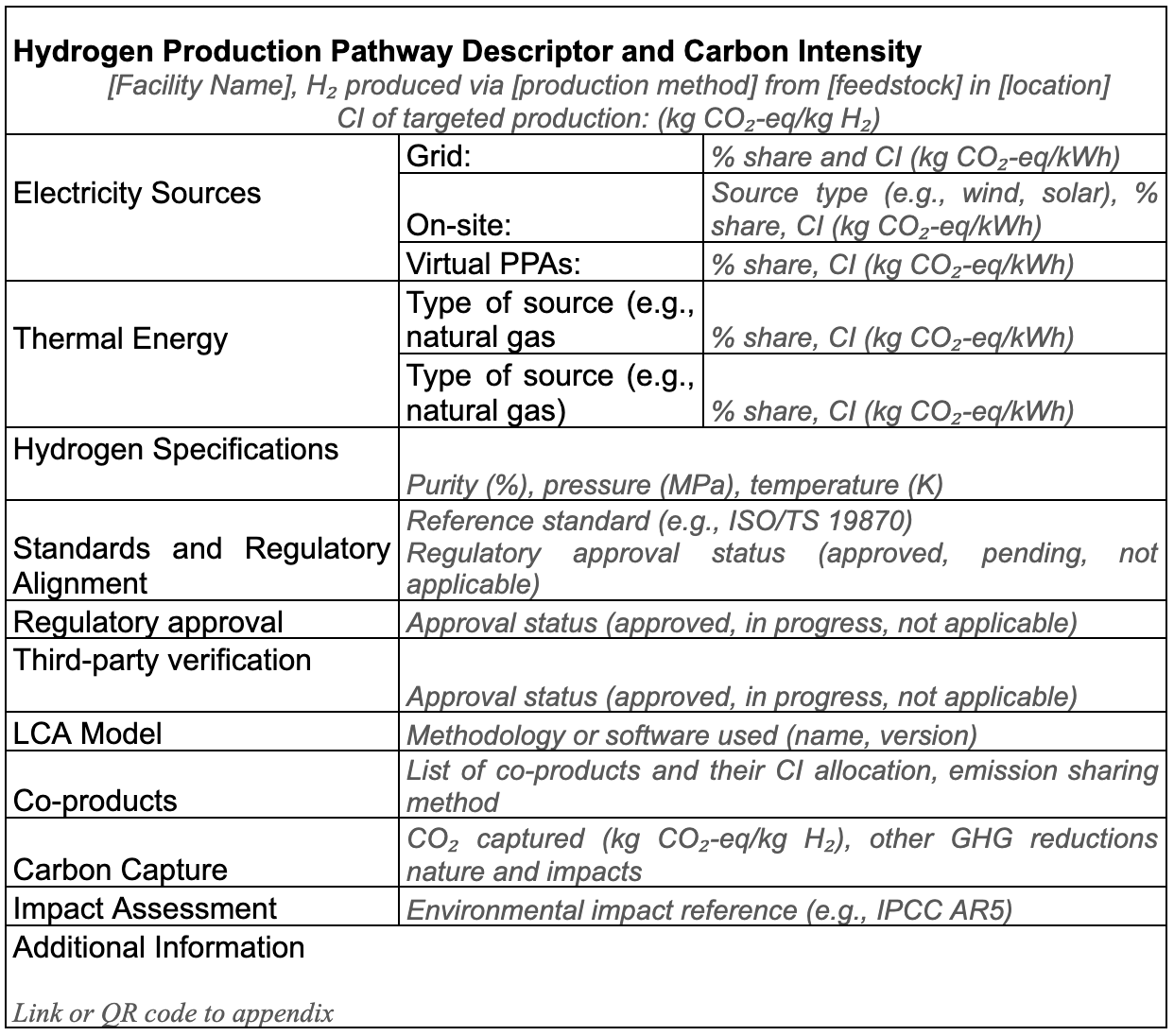
- In terms of information format, the standard has opted for a succinct data sheet to provide essential information on the carbon intensity of hydrogen in a clear and accessible way for all stakeholders. However, it also offers the flexibility to add details in an accompanying document, accessible via a QR code or web link. This approach balances the need for transparency while limiting information overload. It gives producers the opportunity to share more detailed data with those who need it, while preserving the simplicity of the MSDS.
Integration with Global Standards and Policies
The CSA/ANSI R124/BNQ 1789-200 standard aligns with broader regulatory and standards efforts for low-carbon hydrogen. It fits naturally into the Canadian Hydrogen Codes and Standards Roadmap, which aims to harmonise regulatory and standardisation efforts at national and international levels. Its publication meets one of the needs identified in this roadmap.
It aligns also with ISO TS 19870, which offers guidelines for determining GHG emissions across hydrogen’s production, conditionning, and transport. While ISO 19870 covers the full supply chain, CSA/BNQ focuses on production.
The standard also connects with regulations like the U.S. Inflation Reduction Act (IRA) and Canada’s Clean Fuel Regulations, which both encourage emissions reductions and provide financial incentives.
By following CSA/BNQ R124, hydrogen producers can meet these frameworks’ LCA requirements and communicate their assumptions and results effectively.
A Model Data Sheet
The standard allows flexibility in the data sheet’s layout while ensuring key data points are always included. It does, however, provide examples and a model to guide users.
Below is a sample of expected content. Once again, producers can adapt the presentation of this sheet to suit their needs and those of their stakeholders.
Using the Standard to Dispel Uncertainty
Hydrogen producers should use this standard when seeking to demonstrate environmental transparency for their hydrogen production.
Whether for regulatory compliance, funding applications, or market differentiation, it enables clear and effective communication of carbon intensity and key production data.
It will be especially valuable in tenders or partnerships where sustainability is a decisive factor.
Strategic leverage for R&D teams
Beyond transparency, the CSA/BNQ standard is a structuring guide for R&D teams developing hydrogen technologies. By defining a precise format for CI communication, it directly influences early technical and design choices — helping avoid costly redesigns and better guiding innovation.
For companies targeting regulated markets or carbon-reduction funding, it becomes a strategic planning tool.
In pre-feasibility stages, having a clear CI framework supports Go/No-Go decisions. Such informed calls are essential for optimizing R&D budgets in competitive technology environments.
Building Trust Between Stakeholders
As the hydrogen industry grows, moving from color codes to structured and verifiable data marks major progress in how hydrogen is described and assessed.
The standard helps producers share essential summary data on current or planned production, supporting stakeholder trust and engagement.
By favoring transparency over simplification, CSA/ANSI R124/BNQ 1789-200 promotes more rigorous assessment of hydrogen production pathways. This will be essential in developing hydrogen as a clean energy vector and in fighting climate change.
Adopting the standard may be just the first step — future commercial and regulatory interactions will likely involve deeper exchanges and formal guarantees. But the standard will have fulfilled its mission if it helps lay the groundwork for those conversations.
References
- CSA/ANSI R124/BNQ 1789-200 – Harmonized Methodology for Communicating Hydrogen Production Pathway and Carbon Intensity Data
- Hydrogen Certification 101 Hydrogen Certification 101 – Hydrogen Council (2023): https://hydrogencouncil.com/en/hydrogen-certification-101/ Hydrogen Certification 101.
- Methodology for determining greenhouse gas emissions associated with hydrogen production IPHE Methodology for Determining GHG Emissions from Hydrogen Production (2023). Available here: https://www.iphe.net/_files/ugd/45185a_8f9608847cbe46c88c319a75bb85f436.pdf IPHE Hydrogen methodology.
- ISO/TS 19870:2023ISO/TS 19870:2023 – Hydrogen Technologies: Methodology for GHG Emissions from Hydrogen Production, Packaging, and Transport
About the Author
Jérôme is the Chairman, CSA-BNQ Technical Committee Jérôme Gosset is the chair of the CSA-BNQ technical committee that developed the binational hydrogen carbon intensity standard.
As a fractional R&D Operations Executive, he helps CleanTech companies strengthen their R&D performance and reach critical milestones.
For nearly 30 years, he has worked in the low-carbon energy sector, leading efforts to transform R&D into tangible products and successful ventures.
Today, his company Pyonnier supports startups and SMEs in building R&D organizations and commercializing new technologies — with a particular focus on low-carbon energy and hydrogen.